

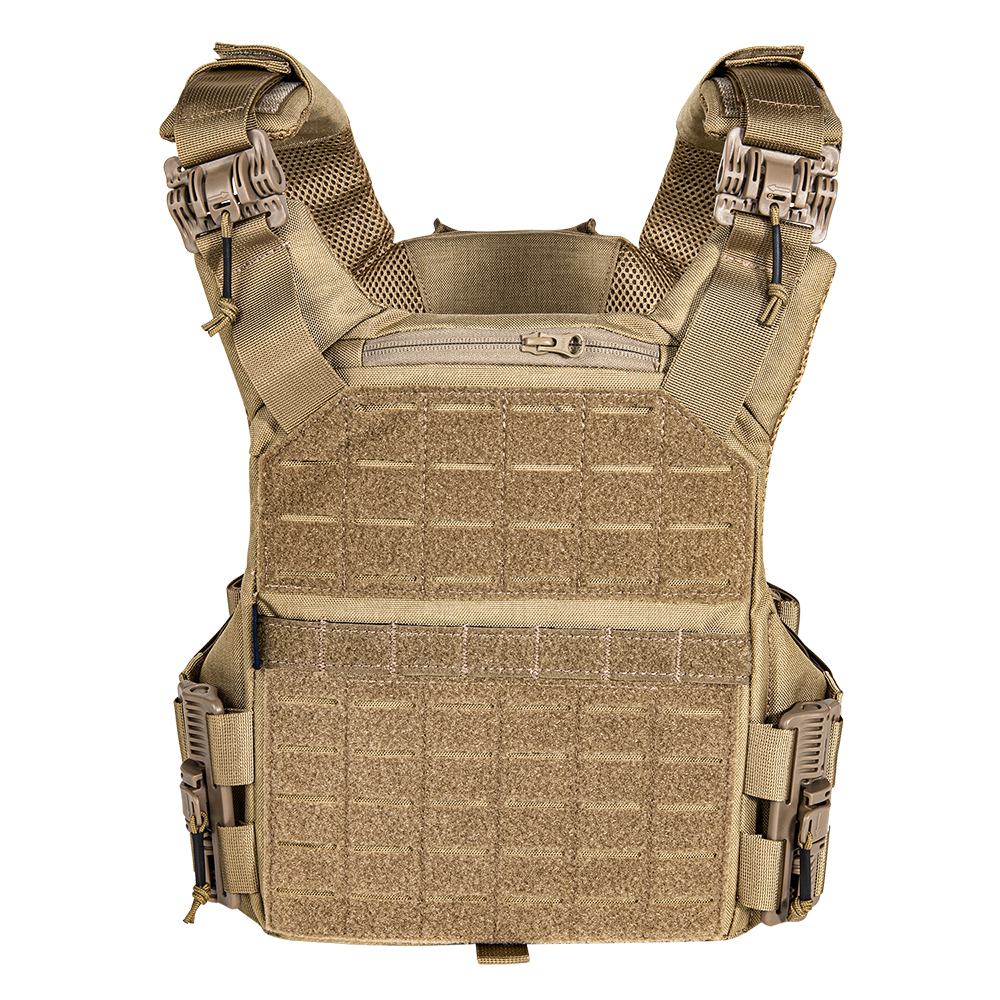
It was not until the 1960s that engineers developed a reliable bulletproof armor that could be worn comfortably. Unlike traditional armor, this bulletproof vest is not made of metal. It is made of advanced woven fibers that can be sewn into vests and other soft clothes, providing more protection for soldiers fighting on the battlefield and thus protecting their bodies on a large scale. Below, the editor will introduce the specific working principle of bulletproof vests.
In fact, hard bulletproof vests provide more protection than soft bulletproof vests, but they are much more troublesome. Police officers and military personnel may wear this protective device when at high risk of attack, but in daily use, they usually wear soft bulletproof vests and flexible protective devices, just like regular shirts or jackets.
Soft bulletproof vests may be a rather mysterious high-tech product for ordinary people like us: how do soft clothes stop bullets? In fact, the working principle is very simple. Essentially, a piece of bulletproof material is just a very sturdy net
The working principle is similar to that of a soccer net
Its working principle is similar to the familiar football net, where the goal is composed of a mesh structure formed by many long ropes that interlock and are fixed to the goal frame. When you kick the football into the goal, the ball will have a certain amount of energy in the form of forward inertia. At this time, the football will keep moving forward. When the ball hits the net, the energy of the impact point is dispersed to a larger area.
The principle of a bulletproof vest is similar to a soccer net, where the long fibers on the vest interweave to form a dense net. Of course, bullets move much faster than football, so the net needs to be made of stronger materials.
From online sources, the editor learned that the most famous material used for bulletproof vests is mostly DuPont's KEVLAR fiber. The material of the bulletproof vest, KEVLAR, is very lightweight and lightweight, just like traditional clothing fibers, but five times stronger than steel of the same weight. When woven into a dense mesh, the material can absorb a large amount of energy, thereby minimizing the impact force of bullets on humans.
In addition to preventing bullets from reaching the human body, bulletproof vests must also prevent blunt injuries caused by bullets. This requires bulletproof materials to be stronger and softer. Kevlar fiber is currently the most commonly used fiber for manufacturing bulletproof vests, but other materials are also under development. It is worth noting that another possible bulletproof fiber is spider silk, but it has not yet been finished.
A bulletproof vest must spread blunt wounds throughout the entire vest, for which the bulletproof material must have a very tight weave. To make it more sturdy, the material is coated with resin material and sandwiched between two layers of plastic film.
Of course, people wearing bulletproof vests will still feel the energy of bullet impact, but it will cover the entire torso rather than specific areas. If it weren't for the close range blow, the victim wouldn't have suffered too much harm.